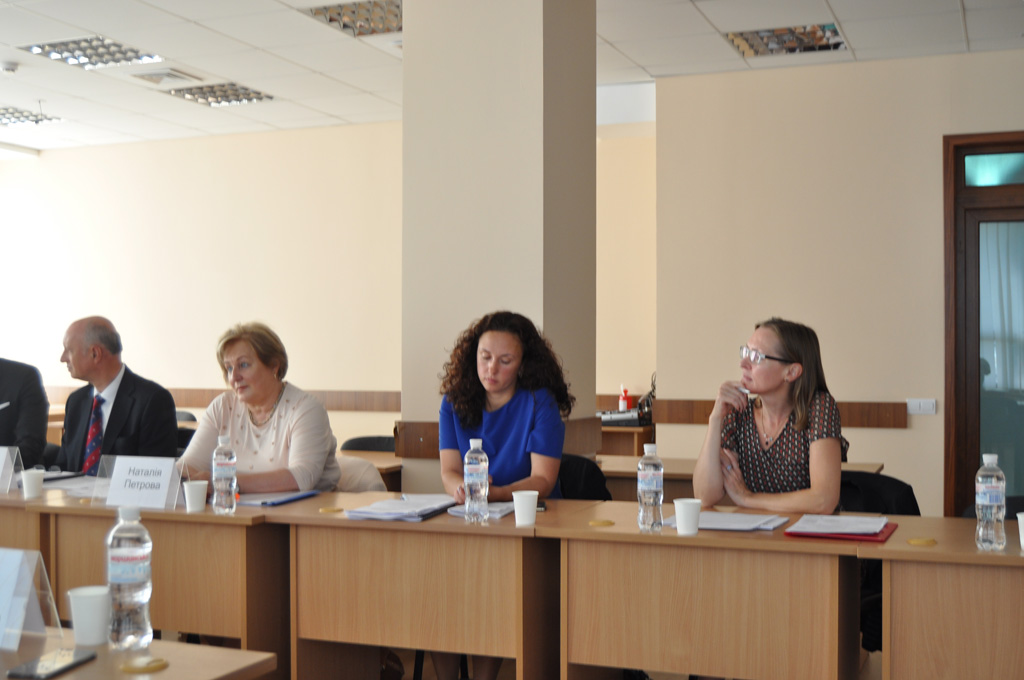
Chairman of the High Qualification Commission of Judges of Ukraine met with representatives of USAID FAIR Justice Project, 16 September, 2016
The Chairman of the Commission held a meeting with representatives of USAID FAIR Justice Project and international expert Mr. Judge Jose Manuel Cardoso, Judge of the Court of Appeal of Lisbon Judicial District, former Head of the Vice-President Cabinet of the High Council of Judges of Portugal, former member of the High Council of Judges of Portugal, on 16 September 2016.
The Commission Chairman informed the Portuguese counterpart about the reforms that are currently taking place in the judicial system of Ukraine. The sides discussed the Portuguese experience in conducting selection of judges to the Supreme Court and recommendations of Mr. Cardoso that will help the Commission to work on the procedure of selection of judges to the Supreme Court and promote the implementation of the Law of Ukraine “On judiciary and the status of judges” in accordance with international experience, relevant standards of independence and accountability of the judiciary.
Justice Jose Manuel Cardoso briefly told about Portuguese judicial system, noting that the highest judicial institution in Portugal under the Constitution is the Supreme Court. It consists of three chambers: civil, criminal and social. The cases considered in separate wards or at their joint meetings. And sometimes they are reviewed at plenary meetings of the Supreme Court. The Supreme Court consists of 62 judges. Its main function is considering appeals on points of law against the decisions of the lower courts.
In addition, every three years the High Judicial Council of Portugal announces the competition to the Supreme Court. To participate in this competition the person should be an appellate court judge, prosecutor or scholar. In majority the Supreme Court of Portugal consist of judges. The candidates are assessed by special competition commission for the selection, which forms three separate rating lists for judges, prosecutors and scholars with different gradation of points for each group of candidates.
During assessment of a candidate, in case he is a judge, his decisions and reputation are subject to verification. The scholars, for example, are asked within their dissertation topic or judgments relating to the dissertation topic or his scholar works. In addition, the candidate must not be brought to disciplinary responsibility in the past. If the candidate was subject to disciplinary sanction at least once, the respective number of points is counted off from the total number of candidate’s points according to the assessment system. That prevents such candidate to pass the competition.
At the end of the meeting, Mr. Jose Manuel Cardoso wished the Commission a successful formation of the new Supreme Court and affirmed about his readiness to keep consulting the High Qualification Commission in the matters of selection in the future.